How to Get Cited in Google AI Overviews
What does Google say about getting cited in AI Overviews?
Eligibility Criteria : Getting Indexed
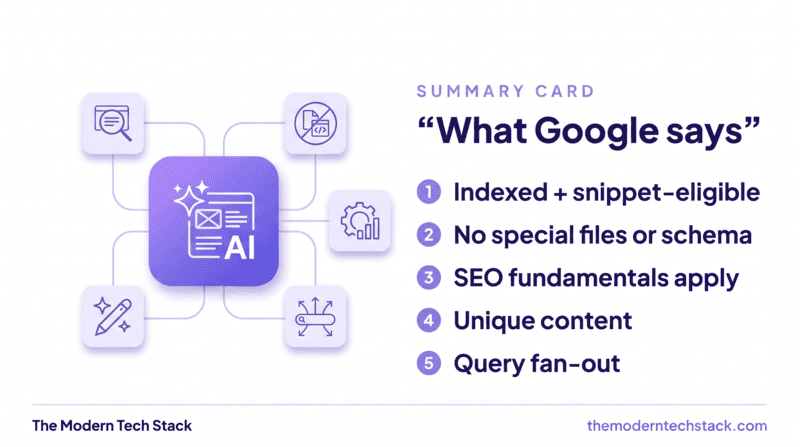
“To be eligible to be shown as a supporting link in AI Overviews or AI Mode, a page must be indexed and eligible to be shown in Google Search with a snippet, fulfilling the Search technical requirements. There are no additional technical requirements.” (Google Search Central)In practice, this means:- Googlebot can crawl the page (not blocked in robots.txt, a CDN, or a firewall).
- The page returns a 200 status and has indexable content.
- The page is actually indexed.
- You haven’t blocked snippets with nosnippet or limited them heavily with max-snippet.
No LLMS.txt and Additional Schema
This is the line most AI Overview advice skips:“There are no additional requirements to appear in AI Overviews or AI Mode, nor other special optimizations necessary.” (Google Search Central)And:“You don’t need to create new machine readable files, AI text files, or markup to appear in these features. There’s also no special schema.org structured data that you need to add.” (Google Search Central)So any tactic sold as an ‘AI Overview hack’ (special files, AI-specific schema, hidden content) isn’t supported by Google’s own documentation.SEO Fundamentals
Google says the best practices for SEO “remain relevant” for AI features, and lists these:- Allow crawling in robots.txt and in any CDN or hosting infrastructure.
- Make content easy to find through internal links.
- Provide a good page experience.
- Make sure important content is available as text.
- Support text with high-quality images and video where relevant.
- Make sure structured data matches the visible text.
- Keep Merchant Center and Business Profile information up to date.
Unique Content
The Mueller post leads with content:“Focus on making unique, non-commodity content that visitors from Search and your own readers will find helpful and satisfying.” (Google Search Central Blog)It adds that in AI search, users ask “longer and more specific questions,” including follow-ups. The post also covers page experience: whether the page works across devices, how fast it loads, and whether visitors can tell the main content apart from everything else.Query Fan-Out
Google explains that AI Overviews and AI Mode may use “query fan-out”, “issuing multiple related searches across subtopics and data sources” to develop a response. This lets Google show a wider and more varied set of links than classic search.This is the most useful technical fact Google has shared. It means a page can be cited because it answers a related sub-question well, not only because it ranks for the exact query typed.Google also notes that AI Overviews and AI Mode may use different models and techniques, so their answers and links can differ. AI Overviews appear only when Google’s systems decide they add something, so they often don’t trigger at all.Can you limit how your content get’s cited in AI Overviews?
If you want to limit how your content appears, Google lists nosnippet, data-nosnippet, max-snippet, and noindex. The Mueller post notes that “more restrictive permissions will limit how your content is featured in our AI experiences.” Google-Extended controls training and grounding for some of Google’s other AI systems. It’s separate from Search.How does Google suggest measuring the value of AI Overview traffic?
Google says it has observed that clicks from results pages with AI Overviews are “higher quality”, with visitors more likely to spend more time on the site. It advises looking at conversions and engagement, not just click counts. That’s Google’s claim about its own product, so treat it as a claim and check it against your own analytics.What do studies and practitioners see in AI Overview mentions and citations?
Observation 1: Rankings help, but less than they used to
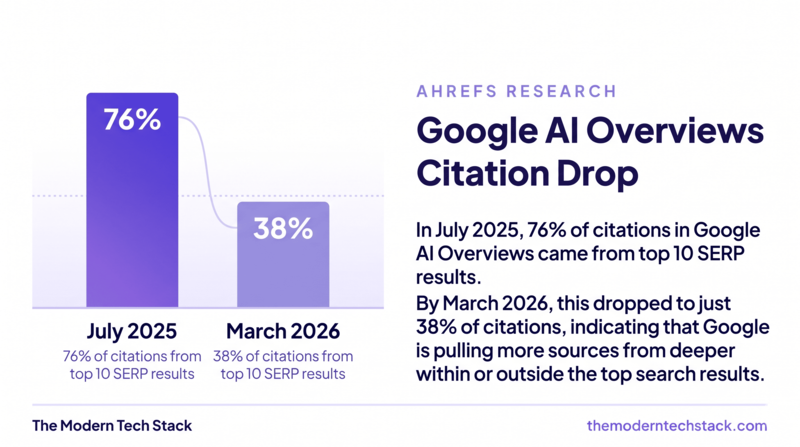
- July 2025: Ahrefs studied 1.9 million citations from 1 million AI Overviews and found that 76% of cited pages ranked in Google’s top 10 for the query. That study looked at the top three citations in each AI Overview.
- March 2026: a larger Ahrefs study of 863,000 keyword SERPs and 4 million AI Overview URLs found that only about 38% of cited pages also ranked in the top 10 for the same query. About 31% ranked in positions 11 to 100, and about 31% didn’t rank in the top 100.
Observation 2: Brand mentions go with AI Overview visibility
Ahrefs’ study of 75,000 brands found that branded web mentions correlated with AI Overview visibility at 0.664, compared with 0.218 for backlinks. A follow-up found the correlation for mentions was higher for AI Overviews (0.65) than for ChatGPT (0.15) or Perplexity (0.30).This is a correlation. Well-known brands get both more mentions and more citations. But it’s consistent across studies, and it suggests that Google’s AI features lean on how widely a brand is discussed.Observation 3: For branded searches, third parties shape the answer
In Ahrefs’ panel of 100 global brands, the most common external sources cited in AI Overviews for brand-name searches were Wikipedia, YouTube, and LinkedIn. In that sample, most AI Overviews for brand names appeared in position one, above the brand’s own site.For SMBs, the takeaway is practical: what Wikipedia (if you have a page), YouTube, LinkedIn, review sites, and directories say about you may appear at the top of your own brand search. Keep those sources accurate.Observation 4: AI Overviews change constantly
According to Ahrefs’ AI Overviews tracker data, an AI Overview has a 70% chance of changing between observations and lasts about 2.15 days on average, and 45.5% of cited sources are new between observations.So a citation you see today may be gone tomorrow, and vice versa. Judge progress by how often you’re cited over weeks, not by one check.Observation 5: Clear, extractable passages get used
Practitioners consistently report that pages with direct answers near the top of a section, clear headings, specific facts, and tables are cited more often. The best supporting research is the GEO paper (KDD 2024), which found that adding statistics, quotations, and source citations improved visibility in generative engine responses by up to 40% in a research setting. Keyword stuffing didn’t help. The research wasn’t run on Google’s AI Overviews specifically, so treat it as directional.Which popular AI Overview tactics lack evidence?
- llms.txt or other AI-specific files. Google says you don’t need them.
- Special “AI Overview schema.” Google says there isn’t any.
- Changing dates without changing content. Updating content genuinely is good practice. Changing the date alone isn’t supported by any evidence we’ve found.
- Writing for AI instead of people. Google’s guidance points the other way.
What should you do to get cited in AI Overviews?
Eligibility (do first)
- [Google] Confirm your key pages are indexed (URL Inspection in Search Console).
- [Google] Check robots.txt allows Googlebot on those pages.
- [Google] Check your CDN, firewall, or bot-protection settings aren’t blocking Googlebot.
- [Google] Confirm pages return a 200 status.
- [Google] Check for nosnippet, data-nosnippet, or tight max-snippet values you didn’t intend.
- [Google] Make sure important content is in the HTML as text, not only in images or client-side scripts.
Content
- [Google] Add something only you can offer: your own data, process, pricing logic, examples, or an informed opinion.
- [Observed] Put a direct answer of two or three sentences near the top of each key section.
- [Observed] Use headings that match real questions, including follow-ups.
- [Observed] Add specifics: numbers, dates, named examples, and sourced statistics.
- [Observed] Use tables for comparisons, pricing, and options.
- [Observed] Cover the sub-questions around your topic, not just the main query. Use People Also Ask, the AI Overview itself, and customer questions to find them. This is how you benefit from query fan-out.
- [Google] Add high-quality images or video where they genuinely help.
Technical and structured data
- [Google] Make sure structured data matches the visible page and validates.
- [Google] Strengthen internal links to the pages you want cited.
- [Google] Check page experience: mobile display, speed, and a clear main content area.
Brand and entity
- [Google] Update your Google Business Profile and, for ecommerce, Merchant Center.
- [Observed] Make your brand description, pricing, and core facts consistent across your site and third-party profiles.
- [Observed] Check what Wikipedia, YouTube, LinkedIn, review sites, and directories say about you, and correct errors.
- [Observed] Earn mentions in the publications and sites already cited in AI Overviews for your topics.
Ranking
- [Observed] Keep working on traditional rankings for your priority queries. They’re not the only route into AI Overviews any more, but they still help, especially for the top citation slots.
How do you monitor your AI Overview visibility?
- Search Console’s generative AI report (free). Google rolled out generative AI performance reports to all sites by August 31, 2026. The report shows impressions of your pages in AI features, broken down by page, country, date, and device, according to Search Console Help. It doesn’t break results down by query.
- A manual check of priority queries. Each month, search your 10 to 20 most important queries and record whether an AI Overview appears and whether you’re cited. Because AI Overviews change so often, run each query a few times and on different days.
- A tracker, when you need scale. Tools such as Semrush, SE Ranking, Ahrefs, Advanced Web Ranking, and AccuRanker track AI Overview presence and citations daily. See our AI Overview tracking guide for a comparison.
- Analytics. Clicks from AI Overviews are counted as ordinary Google organic traffic, so you can’t separate them in analytics. Watch conversions and engagement on the pages you’ve worked on. For tracking traffic from other AI assistants, see our GA4 guide.
How long does it take to get cited in AI Overviews?
Frequently asked questions
How do I get cited in AI Overviews?
Make sure your page is indexed and eligible for a snippet. That’s Google’s only hard requirement. Then follow normal SEO best practices, write unique content that answers the main question and its sub-questions clearly, keep your brand facts consistent, and earn mentions on sites Google already cites. Ranking well helps, but Ahrefs’ 2026 data shows that only about 38% of cited pages also rank in the top 10 for the same query.
Do I need special schema or an llms.txt file for AI Overviews?
No. Google says there’s no special schema.org markup and no need for AI text files to appear in AI Overviews or AI Mode. Ordinary structured data is fine if it matches your visible content.
Does ranking #1 guarantee an AI Overview citation?
No. Rankings help, especially for the most prominent citation slots, but many cited pages don’t rank in the top 10 for the query. Google’s query fan-out means pages can be cited for related sub-questions.
Are AI Overviews and AI Mode optimized the same way?
The same eligibility rules and SEO fundamentals apply to both. Google notes they may use different models and techniques, so the links they show can differ. Track them separately.
Sources and References
Google (official)
- Google Search Central, AI features and your website
- Google Search Central Blog, Top ways to ensure your content performs well in Google’s AI experiences on Search (John Mueller, May 21, 2025)
- Google Search Central Blog, Introducing Search generative AI performance reports
- Search Console Help, Generative AI performance report
Studies and practitioner sources (observational)
- Ahrefs, Update: 38% of AI Overview citations pull from the top 10
- Ahrefs, 76% of AI Overview citations pull from the top 10
- Elmo, Do Google rankings drive AI citations?
- Ahrefs, AI Overviews appear for 83% of branded queries
- Ahrefs, AI Overview brand correlation study
- Ahrefs, Branded web mentions and AI search visibility
- Ahrefs, AI Overviews tracker
- Aggarwal et al., GEO: Generative Engine Optimization, KDD 2024