Best Practices for Answer Engine Optimization: A Practical Playbook
How do we judge which AEO advice to trust?
Grade | What it means | Examples |
|---|---|---|
Strong | Official platform documentation, or peer-reviewed research | Google Search Central, OpenAI help docs, the KDD 2024 GEO paper |
Moderate | Large-sample industry studies (correlational, not peer reviewed) | Ahrefs’ studies of tens of thousands of brands or millions of citations |
Weak | Small tests, case studies, and practitioner observation | Agency case studies, single-site experiments |
Speculative | Plausible ideas without published evidence | New file formats, “AI-only” markup, prompt-injection-style tricks |
Part 1: SEO Foundations
Crawl access: let the right bots in
AI engines can’t cite what they can’t fetch. Every engine has its own crawler, and many sites block some of them without realizing it, often through a CDN or security setting rather than robots.txt.What the platforms say (Strong):- Google: to appear as a supporting link in AI Overviews or AI Mode, a page “must be indexed and eligible to be shown in Google Search with a snippet”. Google says there are no additional technical requirements. It also asks you to make sure crawling is allowed in robots.txt “and by any CDN or hosting infrastructure.”
- OpenAI: for your content to appear in ChatGPT search, OpenAI asks sites to allow OAI-SearchBot, and notes that placement is not guaranteed.
- List the AI crawlers that matter to you (at minimum Googlebot, Bingbot, OAI-SearchBot, and PerplexityBot).
- Check robots.txt for each.
- Check your CDN or firewall bot rules. This is where most accidental blocks happen.
- Fetch a key page as each bot if your tools allow it, and confirm a 200 response with the main content in the HTML.
Make content readable without JavaScript
Some AI crawlers don’t render JavaScript the way Googlebot does. If your key content (pricing, product descriptions, service details) only loads client-side, some engines may see an almost empty page.Evidence grade: Moderate to Weak. This is widely observed by practitioners, and Google’s own guidance asks you to make sure “important content is available in textual form.” How each AI crawler handles JavaScript isn’t fully documented.What to do: view the raw HTML of your top 10 commercial pages (not the rendered page). If the core facts aren’t there, fix that with server-side rendering or static output.Entity clarity: make it obvious who you are
AI systems assemble answers about your brand from many sources. If those sources disagree about what you do, who you serve, or what you cost, the answers will be vague or wrong.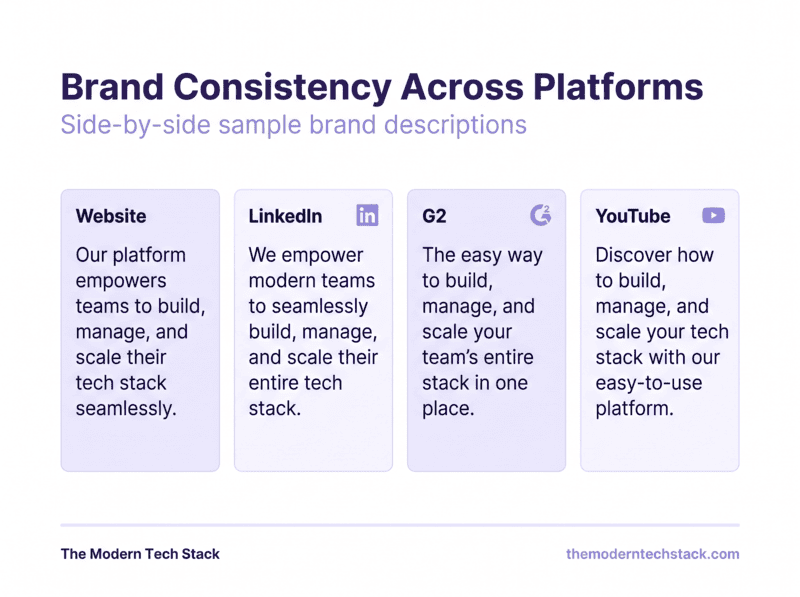
- Write one canonical description. One or two sentences: what you are, who it’s for, and what makes you different. Use it on your homepage, about page, social profiles, directory listings, and press kit.
- Keep the facts consistent. Name, founding year, location, pricing model, and core categories should match everywhere. Contradictions are a common reason AI answers get details wrong.
- Make key facts easy to find on your own site. A clear about page, a pricing page (even if it’s “contact us,” say what drives the price), and pages for each core service or product.
- Update your profiles. Google specifically asks site owners to keep Merchant Center and Business Profile information up to date.
- Use structured data where it already applies, such as Organization, Product, and LocalBusiness markup, and make sure it matches the visible page. Google is clear that no special schema is needed for AI features. Structured data helps with clarity, but it doesn’t unlock AI visibility by itself.
Content structure: make answers easy to extract
AI engines pull passages, not whole pages. Pages that answer a question directly and clearly are easier to use as a source.What the research says (Strong, with caveats): the GEO paper, published at KDD 2024, tested content changes on GEO-bench, a set of 10,000 queries. Some changes improved visibility in generative engine responses by up to 40%. The full paper found that adding quotations, adding statistics, and citing sources performed best. Keyword stuffing gave no improvement and did about 10% worse than the baseline on Perplexity. The caveat: these tests were run in a research setup, not on live commercial engines at scale, and engines have changed since.What to do:- Lead with the answer. Put a direct, two- to three-sentence answer near the top of each section, then expand.
- Use question-style headings where they match how people actually ask.
- Add specifics. Numbers, dates, named examples, and sourced statistics make a passage more useful and more quotable.
- Cite your sources. Link to the primary source for any claim. This matches the GEO findings and is good editorial practice anyway.
- Use tables for comparisons. Pricing, features, and “best for” breakdowns are much easier to extract from a table than from long paragraphs.
- Keep one topic per page. A page that answers one question thoroughly is easier to cite than a page that answers ten briefly.
- Don’t stuff keywords. The research suggests it doesn’t help and may hurt.
Write what only you can write
Google’s guidance for its AI experiences starts with this: “Focus on making unique, non-commodity content that visitors from Search and your own readers will find helpful and satisfying.”For expert SMB owners, this is the biggest advantage you have. AI engines already know the generic answer. What they can’t find elsewhere is your pricing logic, your client data, your process, and your informed opinion. Original data, specific examples, and clear points of view are what make a page worth citing over a summary of other pages.Part 2: Third-party mentions
Why mentions matter
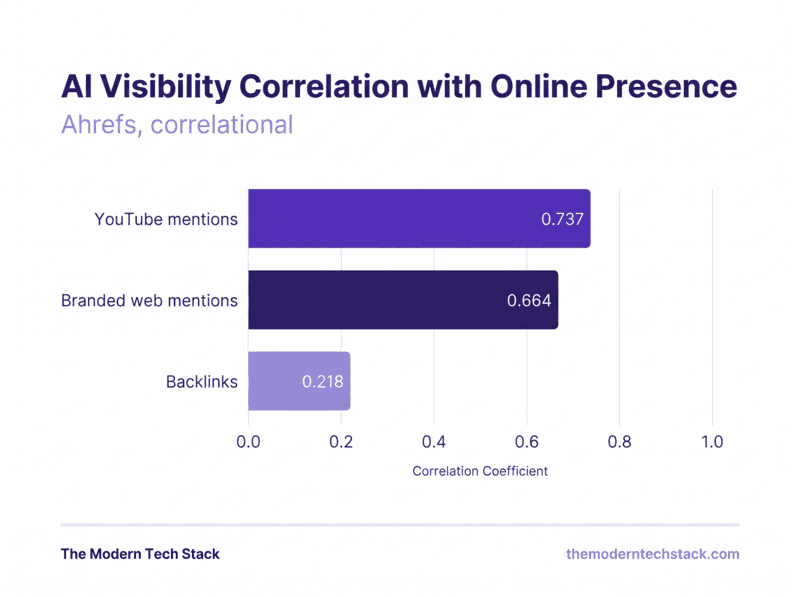
AI engines form their picture of a brand largely from what others say about it. The best evidence here is correlational, but it’s consistent across several large studies.Evidence grade: Moderate.- Ahrefs studied 75,000 brands and found that branded web mentions correlated with AI Overview visibility at 0.664, far more than backlinks did (0.218).
- A follow-up found YouTube mentions correlated at about 0.737, the strongest signal in that study.
- The relationship varies by engine. Ahrefs’ figures for branded mentions were 0.65 for AI Overviews, 0.30 for Perplexity, and 0.15 for ChatGPT.
Where to earn mentions
Not all mentions are equal. Focus on sources AI engines are likely to read and trust for your category.Source type | Why it matters | How SMBs can earn it |
|---|---|---|
Industry publications and trade media | Often cited for category questions | Contribute expert commentary, share original data, respond to journalist requests |
“Best of” and comparison articles | Directly shape “which tool/vendor should I use” answers | Make sure the authors have accurate information; offer a demo or data, not payment |
Review platforms | Engines often draw on review sites for product and service questions | Ask satisfied customers for reviews on the platforms your buyers use |
YouTube | Strongest correlation in Ahrefs’ follow-up study | Publish practical walkthroughs; appear on others’ channels |
Community forums (Reddit, niche communities) | Frequently cited for experience-based questions | Participate genuinely and disclose affiliation. Don’t astroturf |
Podcasts and webinars | Transcripts and show notes create indexable mentions | Guest on shows your buyers listen to |
Partner and customer sites | Integration pages and case studies add credible context | Co-publish case studies; get listed on partner directories |
Find out where your category’s answers come from
Before chasing mentions, look at which sources AI engines actually cite for your key questions. Run your priority prompts in each engine (see our AI visibility audit template) and note every cited domain. Most AI visibility tools also report cited sources.You’ll usually find a short list of domains that appear again and again. Those are your targets. Getting accurately included in three sources that are cited for 40% of your prompts is worth more than 30 random mentions.Fix what’s wrong before adding more
If an often-cited source describes you inaccurately (old pricing, a discontinued product, the wrong category), fix that first. Contact the publisher with a correction and evidence. Inaccurate sources can shape AI answers for months.What not to do
- Don’t pay for placements disguised as editorial. It’s a disclosure risk, and paid listicles are increasingly easy to spot.
- Don’t flood forums with fake accounts. Communities ban it, and it can damage the reputation you’re trying to build.
- Don’t publish self-ranking “best of” lists where you rank yourself first without disclosure and fair criteria. Readers and, increasingly, engines treat these with suspicion.
Part 3: AI engine specific notes
Google AI Overviews and AI Mode
Google’s AI features are closely tied to its search index. Google says the usual SEO best practices remain relevant and that no special optimization is required. Both features may use “query fan-out,” running several related searches to build one answer, which means pages can be cited for queries they don’t rank for directly. Ahrefs’ latest analysis found that about 38% of cited pages also rank in the top 10 for the same query, down from about 76% in its earlier study. Full detail: how to appear in Google AI Overviews.ChatGPT
ChatGPT uses its own search crawler (OAI-SearchBot) alongside partner search results, and its citations overlap less with Google’s top results. Ahrefs found that only about 12% of links cited by ChatGPT, Gemini, and Copilot appear in Google’s top 10 for the same prompt, on average. Ranking well on Google is not enough by itself. Full detail: how to get recommended by ChatGPT.Perplexity
Perplexity searches the web for most answers and shows its sources prominently. In the same Ahrefs study, Perplexity had the highest overlap with Google’s top 10, at nearly one in three citations. Full detail: our Perplexity guide.Gemini, Copilot, and Claude
These matter more in some markets and workplaces than others. Copilot draws on Bing, so Bing Webmaster Tools and Bing indexing deserve a check. For most SMBs, we suggest getting the foundations right and tracking these engines before investing in engine-specific work.Part 4: Speculative Tactics
Tactic | Evidence grade | Our take |
|---|---|---|
Allow search-facing AI crawlers | Strong (platform docs) | Do it. It’s a prerequisite |
Be indexed and eligible for snippets in Google | Strong (Google docs) | Required for AI Overviews and AI Mode |
Add statistics, quotations, and source citations to content | Strong (peer-reviewed, lab setting) | Do it. It’s also good writing |
Avoid keyword stuffing | Strong (peer-reviewed) | It didn’t help in the research |
Keep structured data accurate and matching visible content | Strong (Google docs) | Worth doing; it won’t unlock AI visibility by itself |
Earn branded mentions on trusted third-party sites | Moderate (large correlational studies) | The highest-leverage work for most brands |
Build a YouTube presence | Moderate (correlational) | Strong signal in the data; worth testing |
Consistent entity facts across the web | Moderate (logic plus audit observation) | Low cost, high value; do it |
Answer-first content structure | Moderate (consistent with research and practice) | Do it |
Server-rendered key content | Moderate to Weak | Check your raw HTML |
Freshness updates (“updated 2026”) | Weak | Update for real changes, not to change a date |
llms.txt files | Speculative | Google says you don’t need new AI text files or markup for its AI features. Low cost if you want to try it, but don’t expect results |
“AI-only” schema or hidden text for bots | Speculative / risky | Avoid. Hidden content can break search guidelines |
Prompt-style instructions embedded in pages | Speculative / risky | Avoid. It’s manipulative and likely to be filtered out |
How to treat new advice
When you see a new tactic, ask three questions:- Who’s the source? A platform, a researcher, or a vendor selling a service?
- What’s the sample? One site, one prompt, or thousands?
- Was it causal or correlational? Did they change something and measure, or observe a pattern?
Part 5: Measurement
Expect variation and measure frequency
SparkToro and Gumshoe asked 600 volunteers to run the same prompts 2,961 times. They found less than a 1 in 100 chance of getting the same brand list twice and about a 1 in 1,000 chance of the same order. How often a brand appeared was much more stable. (Evidence grade: Moderate; not peer reviewed.)This means:- Track how often you appear across many runs, not your position in one answer.
- Use a fixed prompt set and run it on a schedule, so the numbers are comparable over time.
- Read trends over weeks, not changes from one day to the next.
What to track
Metric | Source | How often |
|---|---|---|
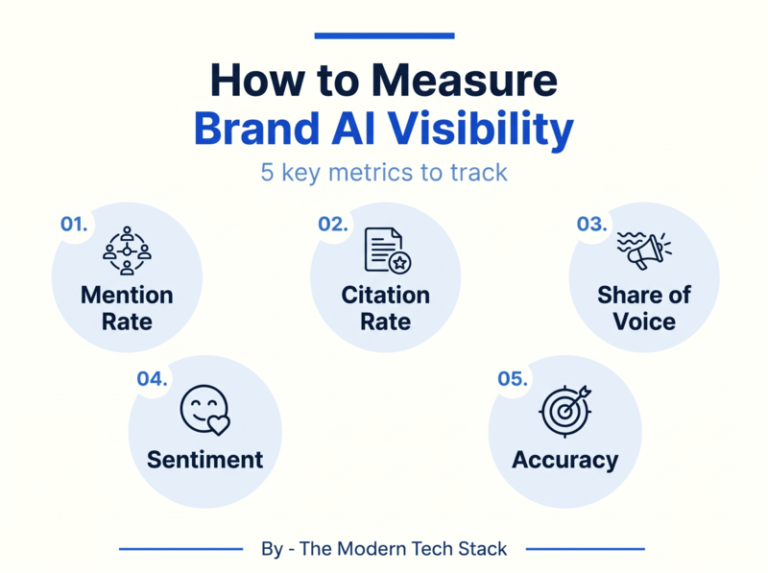
Mention rate across your prompt set, by engine | Manual audit or an AI visibility tool | Monthly (manual) or weekly (tool) |
Citation rate (your URLs linked as sources) | Same | Same |
Accuracy of brand facts in answers | Manual review | Monthly |
Share of voice versus named competitors | Tool or manual audit | Monthly |
Impressions in Google’s AI features | Monthly | |
Sessions from AI assistants | GA4’s AI Assistant channel or a custom channel group (see our GA4 tracking guide) | Monthly |
Conversions from AI referrals | GA4 | Monthly or quarterly |
Start manually, then decide on a tool
For most SMBs, a manual audit of 20–40 prompts across three or four engines is the right starting point. It costs nothing but time and shows you where you stand. Our audit template walks through it step by step.Move to a paid tracker when you need daily data, more prompts, more engines, or competitor share-of-voice at scale. Dedicated trackers start well under $100 a month. Otterly’s Lite plan, for example, is $29 a month for 15 prompts. See our AI visibility tools comparison for options.Connect it to business outcomes
Visibility is a leading indicator. The business case still rests on leads, sales, and pipeline. Google itself advises site owners to look at conversions and the overall value of visits, not just clicks. Also ask new customers how they found you, and add “AI assistant (ChatGPT, Perplexity, etc.)” as an option. For many SMBs, self-reported attribution is the clearest signal of AI-driven demand.What does a 90-day starting plan look like?
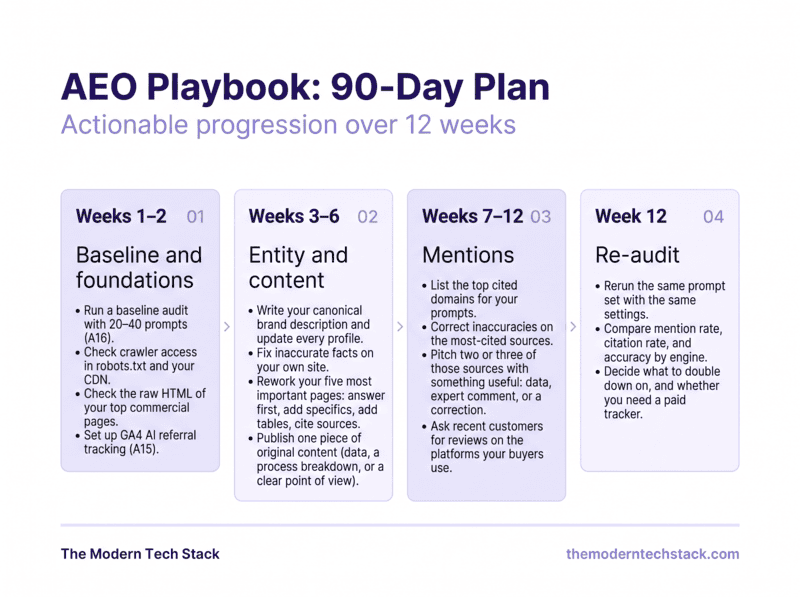
- Run a baseline audit with 20–40 prompts (our audit template).
- Check crawler access in robots.txt and your CDN.
- Check the raw HTML of your top commercial pages.
- Set up GA4 AI referral tracking (our GA4 tracking guide).
- Write your canonical brand description and update every profile.
- Fix inaccurate facts on your own site.
- Rework your five most important pages: answer first, add specifics, add tables, cite sources.
- Publish one piece of original content (data, a process breakdown, or a clear point of view).
- List the top cited domains for your prompts.
- Correct inaccuracies on the most-cited sources.
- Pitch two or three of those sources with something useful: data, expert comment, or a correction.
- Ask recent customers for reviews on the platforms your buyers use.
- Rerun the same prompt set with the same settings.
- Compare mention rate, citation rate, and accuracy by engine.
- Decide what to double down on, and whether you need a paid tracker.
Frequently asked questions
How do you optimize for AI search?
Start with the foundations: make sure AI crawlers can access your site, make your brand facts clear and consistent, and structure content so answers are easy to extract. Then work on earning mentions on the third-party sites AI engines cite for your category. Measure how often you appear across a fixed set of prompts, not your position in one answer.
Is generative engine optimization different from SEO?
It overlaps heavily. Google says the usual SEO practices still apply to its AI features. The main differences are the greater weight of third-party mentions, the need to allow each engine’s crawler, and measurement based on frequency rather than position. See GEO, AEO and LLM SEO explained.
Do I need an llms.txt file?
There’s no published evidence that it improves AI visibility, and Google says you don’t need new AI text files for its AI features. It’s harmless to add, but don’t prioritize it.
How long does it take to improve AI visibility?
It depends on the change. Fixing a crawler block or a wrong fact on your site can show up in weeks. Building third-party mentions usually takes months. Track monthly and judge trends over a quarter.
Sources and References
Strong
- Google Search Central, AI features and your website
- Google Search Central Blog, Top ways to ensure your content performs well in Google’s AI experiences on Search (May 2025)
- OpenAI Help Center, ChatGPT search
- Aggarwal et al., GEO: Generative Engine Optimization, KDD 2024 (full text)
- Search Console Help, Generative AI performance report
Moderate
- Ahrefs, AI Overview brand correlation study (75K brands)
- Ahrefs, AI brand visibility correlations
- Ahrefs, Branded web mentions and AI search visibility
- Ahrefs, Update: 38% of AI Overview citations pull from the top 10
- Ahrefs, Only 12% of AI-cited URLs rank in Google’s top 10
- SparkToro, AIs are highly inconsistent when recommending brands
Pricing
- Otterly.AI, Pricing