AI Search visibility
You’d have probably noticed that some of your prospects no longer start with a Google search. They ask ChatGPT, Perplexity, or Google’s AI Mode for a shortlist, and arrive at your sales call with their mind half made up. AI search visibility is the term for whether, and how, your business shows up in those answers.
What is AI search visibility?
AI search visibility is how often, how prominently, and how accurately AI assistants mention your brand or cite your website when people ask questions relevant to what you sell. It covers chat assistants like ChatGPT, Claude, Gemini, and Copilot, AI search engines like Perplexity, and the AI-generated answers inside Google Search (AI Overviews and AI Mode). Unlike a search ranking, it isn’t a fixed position. It’s a probability: the share of relevant answers in which you appear.
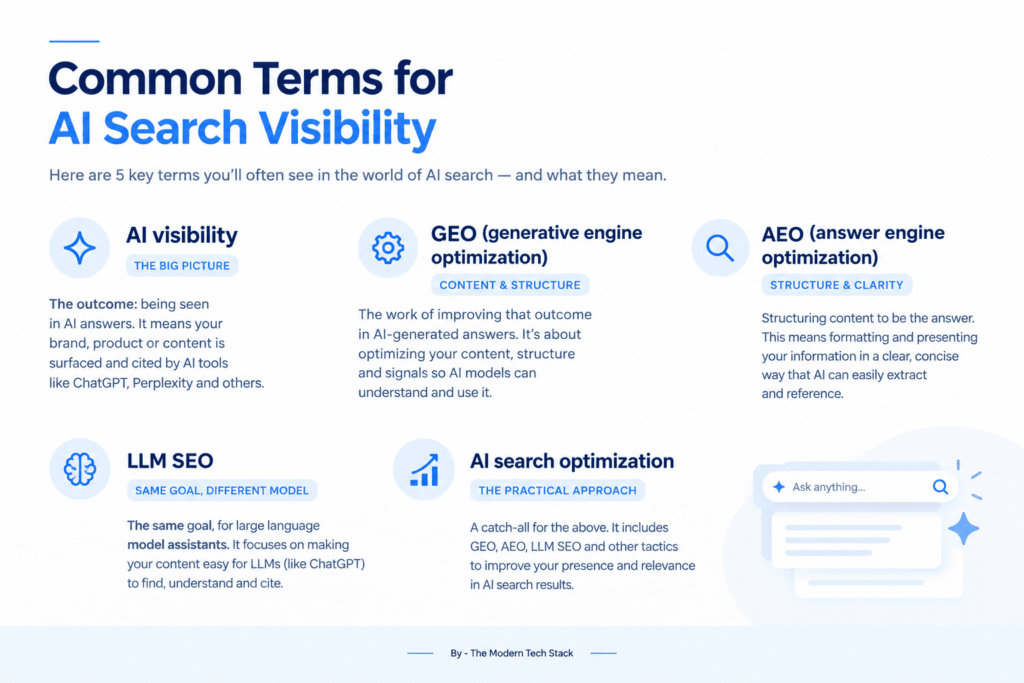
Term | What it emphasizes | Where you’ll see it |
|---|---|---|
AI visibility | The outcome: being seen in AI answers | Tool vendors, brand teams |
GEO (generative engine optimization) | The work of improving that outcome in AI-generated answers | SEO practitioners; from a 2023 research paper |
AEO (answer engine optimization) | Structuring content to be the answer | Older term from the featured-snippet and voice-search era |
LLM SEO | The same goal, for large language model assistants | Agency marketing |
AI search optimization | A catch-all for the above | General business press |
You’ll see at least five terms used, often in the same article. In our view: these describe one discipline viewed from slightly different angles. “AI visibility” is the outcome you measure; GEO and AEO are the work you do to improve it. Don’t let vendors convince you that each label needs its own budget. For the full comparison with traditional SEO, see GEO vs AEO vs SEO. For definitions and origins, see GEO, AEO and LLM SEO explained.
There are four distinct signals that are commonly referred to measure ai search visibility
1. Mentions
This refers to the number of times AI names your brand in its answer. A mention can happen with or without a link.Why it matters: Mentions shape the buyer’s shortlist, even if nobody clicks. Many buying decisions now start with an AI-generated shortlist.2. Citations
The number of times AI links to your website as a source. Your page might be cited for a fact, a definition, or a comparison, even in answers that don’t name you as a recommendation.Why it matters: Citations can send traffic, and they show that AI systems treat your content as a credible source. You can be cited without being recommended, and recommended without being cited.3. Referrals
A person clicks through from an AI answer to your site. This is the only one of the four signals your analytics can see directly, and only when the AI platform passes referrer information. We cover setup in how to track AI referral traffic in GA4.Why it matters: Referrals are the signal closest to revenue. But they understate your true AI influence, because most answers don’t produce a click.4. Crawler hits
AI companies’ bots (such as OpenAI’s OAI-SearchBot) visit your pages. These show up in your server logs, not in your analytics.Why it matters: Crawling is a prerequisite, not an outcome. If AI crawlers can’t reach your site, you can’t be cited in live answers. OpenAI states that sites must allow OAI-SearchBot to be eligible for ChatGPT search. But being crawled doesn’t mean you’ll be mentioned.
With traditional search, you can look up your ranking for a keyword and it’ll be roughly the same tomorrow. AI answers don’t work that way.Research by SparkToro and Gumshoe.ai, in which 600 volunteers ran the same 12 prompts 2,961 times, found there was less than a 1 in 100 chance that ChatGPT or Google’s AI would give the same list of brands in any two responses. The same list in the same order was closer to 1 in 1,000. The study also found that how often a brand appears across many runs was far more stable than its position, which is why sound AI visibility measurement counts frequency rather than rank. The study hasn’t been peer reviewed, and the authors called for larger follow-up work.What an AI visibility score means: Most tools turn this into a single number, usually the share of tracked prompts in which you appear, sometimes weighted by position or compared against competitors. Because every tool uses a different set of prompts and engines, you can’t compare a score from one tool with a score from another. We explain why in how AI visibility is measured.
Not every business needs to invest now. Here’s how we’d think about it by company size.
Small businesses and solo experts (under 20 people)
When it matters: If your buyers research before contacting you (professional services, B2B software, specialist trades, considered purchases), AI answers are probably already shaping their shortlist.What to do: A monthly manual check of 15–20 prompts, a technical check that AI crawlers can reach your site, and a push to get accurately listed on the directories and review sites in your category. No paid tool is needed yet.When it matters less: Businesses that win mostly through referrals, walk-ins, or a small number of long-term relationships may see little effect for now.Mid-sized companies (20–200 people)
When it matters: Almost always, if you sell to other businesses or compete in a crowded category. Prospects increasingly shortlist vendors without ever visiting your site.What to do: Track 25–100 prompts across the two or three engines your buyers use, assign someone to own your third-party presence, and add AI visibility as a section in your monthly marketing report. This is where a paid tool usually starts to justify its cost. See our guide to AI visibility tools.Larger organizations (200+ people)
When it matters: Now. At this size, the risk is not just being left out but being described inaccurately, at scale.What to do: Treat AI visibility as a reporting channel within search, with metrics broken down by engine and market. Monitor accuracy as closely as presence, and set governance for which AI crawlers you allow.
First, much of your AI visibility is decided off your own website. In a study of 75,000 brands, Ahrefs found that branded web mentions had the strongest correlation (0.664) with visibility in Google’s AI Overviews, far stronger than backlinks (0.218). A follow-up study found YouTube mentions correlated even more strongly across ChatGPT, AI Mode, and AI Overviews. These are correlations, not proof of cause, and Ahrefs says so.Second, the basics still apply. Google says there are “no additional requirements to appear in AI Overviews or AI Mode, nor other special optimizations necessary” beyond being indexed and eligible to show a snippet.Put together: make sure you’re crawlable and clear on your own site, then put most of your effort into being discussed accurately elsewhere.
Step 1: Audit
Run a one-time check to find out where you stand:- Write 15–30 prompts a buyer would realistically ask, across the buying journey (problem, category, comparison, and “best for” questions).
- Run them in the engines your buyers use, in fresh sessions.
- Record mentions, citations, accuracy, and which competitors appear.
Step 2: Measure
Decide what you’ll track monthly. For most businesses, three metrics are enough:- Mention rate: the share of your prompts in which you appear
- Citation rate: the share in which your site is linked
- Accuracy: whether the AI describes you correctly
Step 3: Improve
Work in this order, from most within your control to least:- Access: Make sure AI crawlers aren’t blocked by robots.txt, security plugins, or CDN settings.
- Clarity: Publish key facts (what you do, who for, pricing, locations) as plain text on your site.
- Presence: Get accurately included on the third-party pages AI systems already cite for your category.
- Depth: Build content that answers the follow-up questions buyers ask, with specific facts and sources.
AI Overviews: AI-generated summaries that appear at the top of some Google search results, with links to sources.
AI Mode: Google’s conversational AI search experience, which handles longer, multi-part questions.
Citation: A link to your website shown as a source in an AI answer.
Entity: The thing an AI system understands your business to be: its name, category, location, and attributes.
Mention: Your brand named in an AI answer, with or without a link.
OAI-SearchBot: OpenAI’s crawler for ChatGPT search. Your site must allow it to be eligible for ChatGPT’s live search results.
Prompt: A question or instruction given to an AI assistant. AI visibility tools track a fixed set of prompts over time.
Query fan-out: Google’s process of running multiple related searches across subtopics to build one AI answer.
Referral: A visit to your site from a link in an AI answer, visible in analytics.
Share of voice: Your mentions as a percentage of all brand mentions in a set of AI answers.
Visibility score: A tool-specific number summarizing how often you appear across its prompt set. Not comparable between tools.
- New to the terms? GEO, AEO and LLM SEO explained
- Wondering if this is just SEO? GEO vs AEO vs SEO
- Ready to check where you stand? AI visibility audit template
- Considering a tool? Best AI search visibility tools
- Need to report numbers? How AI visibility is measured
- Ready to act? AI search optimization playbook
- Google Search Central, AI features and your website
- OpenAI Help Center, ChatGPT search
- SparkToro and Gumshoe.ai, AIs are highly inconsistent when recommending brands or products
- Ahrefs, AI Overview brand visibility factors (75K brands) and brand visibility factors in ChatGPT, AI Mode and AI Overviews
- Aggarwal et al., GEO: Generative Engine Optimization (KDD 2024)