AI MARKET INTELLIGENCE
The AI Outbound Tech Stack By Company Stage
AI has made outbound cheaper to run, and also much noisier. According to Digital Applied, the average rep’s monthly outbound volume has risen from about 1,150 messages to 7,400 with AI assistance, while raw reply rates have fallen from 4.7% to 2.9%. The same report finds that 41% of enterprise B2B teams now run at least one AI SDR in production. More activity has not led to better results, and the reason is usually the stack: which layers a company has, how they connect, and whether they match the problem the company is actually trying to solve.
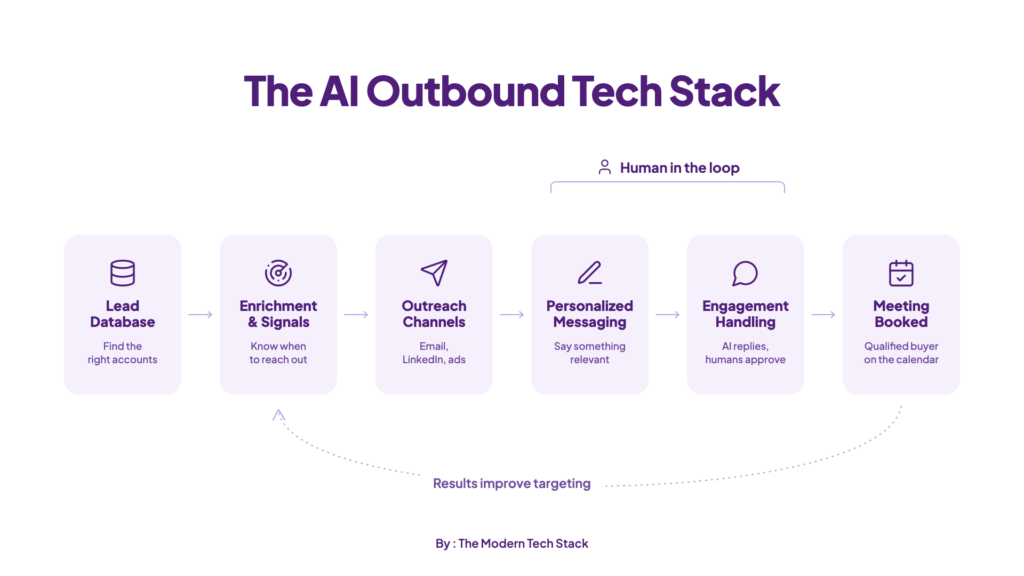
An AI outbound tech stack is the set of tools that moves a prospect from an unknown name to a booked meeting. It has six layers. The first is a lead database, which supplies the companies and contacts. The second is enrichment and signals, which add context and tell you when to reach out. Next come outreach channels such as email, LinkedIn and targeted ads, and personalized messaging for what you say on them. The fifth layer is engagement handling, which manages replies and conversations, and the last is meeting booking, which turns interest into time on the calendar. AI now plays a part in every layer. What separates teams that get results from those that do not is how well the layers connect and where people still review the work.
Enrichment once meant adding a job title, company size and industry to a contact record, usually once. Now it runs continuously, and the useful question is no longer who a prospect is but what has changed for them recently. External signals include job changes, funding rounds, hiring activity, leadership moves and company news. Internal signals come from a company’s own data, such as visits to the pricing page, product usage and past conversations in the CRM. Job changes are among the strongest of these signals. UserGems reports that UserTesting doubled its response rate and generated $25M in revenue by tracking past champions who moved to new companies. Platforms such as Common Room now capture more than 50 signal types and link them to the specific person behind the activity. The newest step is the context summary. Research agents such as Clay’s Claygent read live sources and compress them into a short brief on each account, so a rep or AI writer begins with a clear view of why this account matters right now.
Email remains the backbone of outbound, with LinkedIn and account-based ads alongside it to keep a brand in front of the same buyers. AI has made each channel easier to run at volume, but buyers and inbox providers have tightened their limits in response. Gmail, Yahoo and Outlook now require bulk senders to authenticate their domains and keep spam complaints below 0.3%, according to Courier. LinkedIn caps connection requests at about 100 per week across all account types, as Salesforge notes. Within these limits, sending more is rarely the answer, and messaging quality becomes the main constraint.
Signals are only as useful as the message built on them. AI writers can now draft a first line from a funding round or a new hire within seconds, but they can also invent details, misread context or produce copy that buyers recognize as automated. These failures are costly. Pyng, citing Autobound’s analysis, reports annual churn of 50% to 70% for fully autonomous AI SDR tools, compared with 25% to 35% for human SDRs, and points to hallucinated personalization and the absence of a human quality check as leading causes. A person who reviews templates, checks samples and approves new campaigns before launch remains the most reliable safeguard.
The aim of a first message is a reply, and replies are where AI agents are now taking on more work. Instead of sending every response to a rep, agents read intent, answer common questions, handle routine objections and follow up on their own. Most mature tools let teams increase the agent’s autonomy in stages. Instantly’s Reply Agent offers a human-in-the-loop mode, in which the agent drafts and a person approves, alongside a full autopilot mode. Reply.io describes the same gradual progression from drafts for approval to supervised sending and then to autonomous operation. The sensible path is to keep a person approving responses until the agent’s answers are consistently accurate, and to keep pricing questions and complex objections with a human after that.
Every conversation should lead toward a booked meeting with a qualified buyer, and speed matters. Chili Piper reports that the odds of qualifying a lead drop by 80% after five minutes without a response. An agent that replies instantly but books the wrong people simply moves the problem to the sales team. Booking well depends on training. The agent needs clear qualification criteria, routing rules and examples of good and bad conversations, and its results should be reviewed regularly. Meetings that turn into real opportunities should also feed back into the targeting rules, which is what makes the stack improve over time.
Every company needs all six layers eventually, but not all at once. Which layers deserve the most investment depends on the problem a company faces at its current stage of outbound maturity, which does not always match its headcount.
Early-stage founders are not yet scaling outbound. They are testing whether it can work at all, which means finding out who buys, which message earns replies and whether outbound justifies the time it takes. The stack should stay small: a lead database, a sending tool and the founder’s own judgment on messaging. Apollo offers a free tier, with paid plans from $49 per user per month, and Instantly’s Growth plan costs $47 a month for 5,000 emails. Autonomous agents add little at this stage, because automating an untested message only spreads its weaknesses faster.
When several reps begin running outbound, results start to vary from rep to rep and month to month. The usual causes are uneven research, inconsistent data and lists that include too many poor-fit accounts. The task now is to turn early wins into a dependable pipeline without adding headcount, which shifts investment toward enrichment and signals. Clay starts at $185 a month, and its customers report significant gains. Sendoso achieved 10x outbound productivity and more than $1M in pipeline, while Oyster saved 40 hours a month per rep. This is also the right stage to pilot a reply agent in human-in-the-loop mode on a limited set of accounts.
Larger teams face a different problem. Their competitors also use AI, buyers receive more outreach than ever and generic messages are ignored. The advantage now comes from timing, meaning reaching accounts when signals suggest they are ready to buy, and from context, meaning messages that reflect a real understanding of the account. Investment shifts toward signal platforms, research agents and engagement platforms with governance built in. Data costs rise accordingly. ColdIQ puts the median ZoomInfo contract at $31,875 a year. The results can justify the cost: Clay reports that Intercom grew its outbound-sourced pipeline by 140% using agents that continually research target accounts.
The most effective AI outbound stack is rarely the largest. It is the one that solves the current constraint, whether that is an unproven message, inconsistent pipeline or a lack of relevance at scale, and then expands as the next constraint appears. Human review should begin heavy and decrease gradually as the system earns trust.
Note on sources: Case-study figures from Clay, UserGems, Instantly and Chili Piper come from the vendors’ own published materials.
- Digital Applied, “AI SDR Statistics 2026: Outbound Sales Data Points.” https://www.digitalapplied.com/blog/ai-sdr-statistics-2026-outbound-sales-data-points
- UserGems, “UserTesting’s Pipeline Generation Strategy.” https://www.usergems.com/blog/usertestings-pipeline-generation-strategy
- Common Room, “Account-Based Marketing Solutions.” https://www.commonroom.io/solutions/abm/
- Clay, “Account Research Use Case (Claygent).” https://www.clay.com/use-cases/account-research
- Courier, “Email Sender Requirements: Gmail, Yahoo and Outlook.” https://www.courier.com/blog/email-sender-requirements
- Salesforge, “LinkedIn Connection Request Limit.” https://www.salesforge.ai/blog/linkedin-connection-request-limit
- Pyng, “Why AI SDRs Fail.” https://pynghq.com/blog/why-ai-sdrs-fail/
- Instantly, “Setting Up AI Agents” (Reply Agent modes). https://instantly.ai/courses/setting-up-ai-agents
- Reply.io, “The AI SDR Model.” https://how.reply.io/learn/ai-sdr-model/
- Chili Piper, “Inbound Scheduling Automation.” https://www.chilipiper.com/article/inbound-scheduling-automation
- SalesIntel, “How Much Does Apollo Cost?” https://salesintel.io/blog/how-much-does-apollo-cost/
- Instantly Help Center, “Instantly Plans Overview.” https://help.instantly.ai/en/articles/10273259-instantly-plans-overview
- Clay, “What Is Changing” (pricing). https://www.clay.com/faq/what-is-changing
- Clay, “Sendoso Customer Story.” https://www.clay.com/customers/sendoso
- Clay, “Oyster Customer Story.” https://www.clay.com/customers/oyster
- Clay, “Customers” (Intercom result). https://www.clay.com/customers
- ColdIQ, “ZoomInfo Pricing.” https://coldiq.com/blog/zoominfo-pricing